
Source: the Free Press
Transcript of the newspaper article is below
Buried Under Falling Walls at a Fire Early This Morning.
STERLING’S SHOE FACTORY DESTROYED.
Firemen Swanwick, Seccombe, Robertson and Robinson Injured, the First Two Badly.
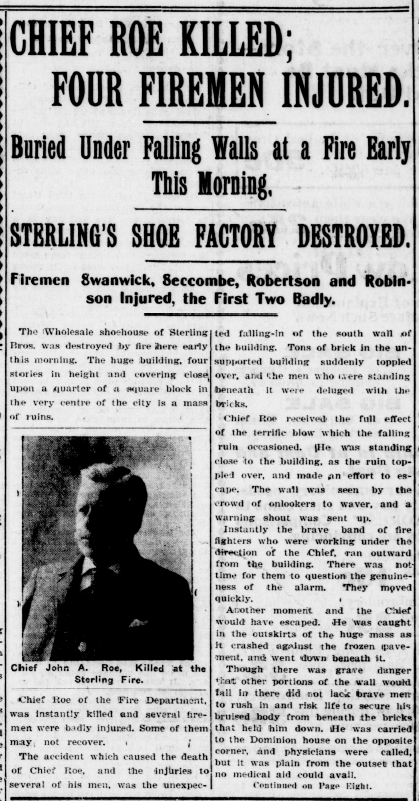
The wholesale shoehouse of Sterling Bros. was destroyed by fire early this morning. The huge building, four stories in height and covering close upon a quarter of a square block in the very centre of the city, is a mass of ruins.
Chief Roe of the Fire Department was instantly killed and several firemen were badly injured. Some of them may not recover.
The accident which caused the death of Chief Roe and the injuries to several of his men was the unexpected falling-in of the south wall of the building. Tons of brick in the unsupported building suddenly toppled over, and the men who were standing beneath it were deluged with the bricks.
Chief Roe received the full effect of the terrific blow when the falling ruin descended. He was standing close to the building, as the ruin toppled over, and made an effort to escape. The wall was seen by the crowd of onlookers to waver, and a warning shout was sent up.
Instantly the brave band of fire-fighters who were working under the direction of the Chief ran outward from the building. There was not time for them to escape the full weight of the masonry. They moved quickly.
Acting Foreman Seccombe seemingly should have escaped. He was caught at the outskirts of the falling mass and was crushed against the frozen pavement, and went down beneath it.
Though there was grave danger that other portions of the wall would fall if he did not act, brave men ran to his aid and succeeded in rescuing his bruised body from beneath the bricks that held him down. He was hurried to the offices of Dr. Fraser, close at hand, and physicians were called, but it was soon seen that without medical aid counsel could avail.
The Chief’s body showed the terrible effects of the accident which had befallen him. He was almost unrecognizable as he lay in the hotel office, his face battered and clothing torn.
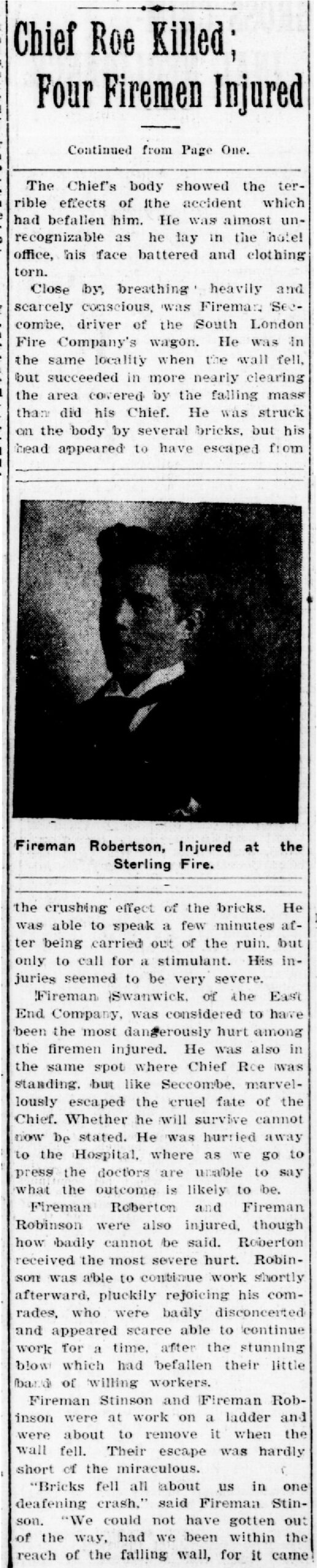
Close by, breathing heavily and scarcely conscious, was Fireman Seccombe, driver of the South London Fire Company’s wagon. He was in the same locality when the wall fell, but succeeded in more nearly clearing the area covered by the falling mass than did his Chief. He was struck on the body by several bricks, but his head appeared to have escaped from the crushing effect of the bricks. He was able to speak a few minutes after being carried out of the ruin, but only to call for a stimulant. His injuries seemed to be very severe.
Fireman Swanwick, of the East End Company, was considered to have been the most dangerously hurt among the firemen injured. He was also in the same spot where Chief Roe was standing, but, like Seccombe, marvellously escaped the cruel fate of the Chief. Whether he will survive cannot now be stated. He was hurried away to the Hospital, where, as we go to press, the doctors are unable to say what the outcome is likely to be.
Fireman Robertson and Fireman Robinson were also injured, though how badly cannot be said. Robertson received the most severe hurt. Robinson was able to continue work shortly afterward, pluckily rejoining his comrades, who were badly disconcerted and appeared scarce able to continue work for a time, after the stunning blow which had befallen their little band of willing workers.
Firemen Stinson and Fireman Robinson were at work on a ladder and were about to remove it when the wall fell. Their escape was hardly short of the miraculous.
“Bricks fell all about us in one deafening crash,” said Fireman Stinson. “We could not have gotten out of the way, had we been within the reach of the falling wall, for it came
down so suddenly and without warning. It was just like a great dark cloud sweeping across and blotting out for a moment the red glare of the fire. Then there was the cry of the crowd and of some of our own men to look out; that the wall was coming down, but it is my opinion that the Chief could scarcely have heard it.”
The fire broke out about 1:30 o’clock, but by the time the firemen were notified the building was fully in the power of the dread element, though this was not then apparent, for the fire fiend had taken full hold within the building before making much of an appearance without.
When the firemen broke into the building there belched forth a terrific sea of flame. The fire roared madly, and swept upwards in the shortest time imaginable. It seemed but a few moments when the fire had eaten its way into the roof of the building, and in less than an hour what was once one of the finest and newest wholesale blocks in the city was nothing but four blackened, irregular walls, standing out against the bright sky of the winter’s night.
The Sterling block was erected three or four years ago, and was of red brick. It cost in the neighborhood of $25,000. The firm carried a large stock of goods, and the total loss will not run short of $50,000, and very probably will be much heavier.
Mr. Sterling, when acquainted with the fact of the fire, was ill in bed, and no statement could be obtained from him.
The absence of the long-delayed fire engine for the department was noticeable. The streams of water were barely able to reach to the top of the burning pile, and lacked force.
The fire broke out in the upper part of the building, and though the firemen were quickly at work, the flames spread rapidly, and in a very short time the entire structure was one great blaze. Streams were poured on the flames from all sides, there being evident danger of their spreading to the premises of Gorman, Eckert & Co., on the north. At 3 a.m. the fire was not under control, but strong hopes were indulged in by the citizens who had assembled at the scene, that the fire would be confined to the Sterling building.
In its descent the south wall struck and demolished a telephone wire, and as a consequence destroyed the telephone service in that district.
THE DEAD CHIEF
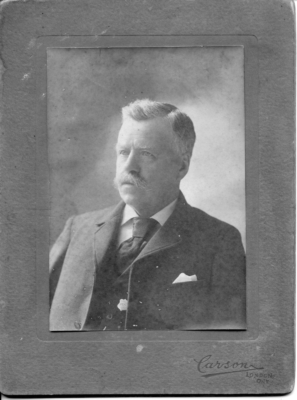
John A. Roe, the dead Chief of the Fire Brigade, was the oldest fireman in the city’s service, having been connected with the force in the days of volunteer firemen. On the retirement of Mr. Thomas Wastie from the chiefship many years ago, Mr. Roe, who for some time had held the position of First Assistant, was promoted and had held the office of Chief up to the time of his death.
Mr. Roe was a thorough, fearless fireman, and this latter characteristic more than once nearly cost him his life.
In the language of Fireman Taylor, this morning, “Chief Roe was the finest fellow that ever lived.”
About ten years ago Chief Roe was badly injured in an accident which occurred at the corner of King and Talbot Streets. There was an exhibition run, and in rounding the corner the hose wagon on which he was standing was tipped over and he was thrown against the building.