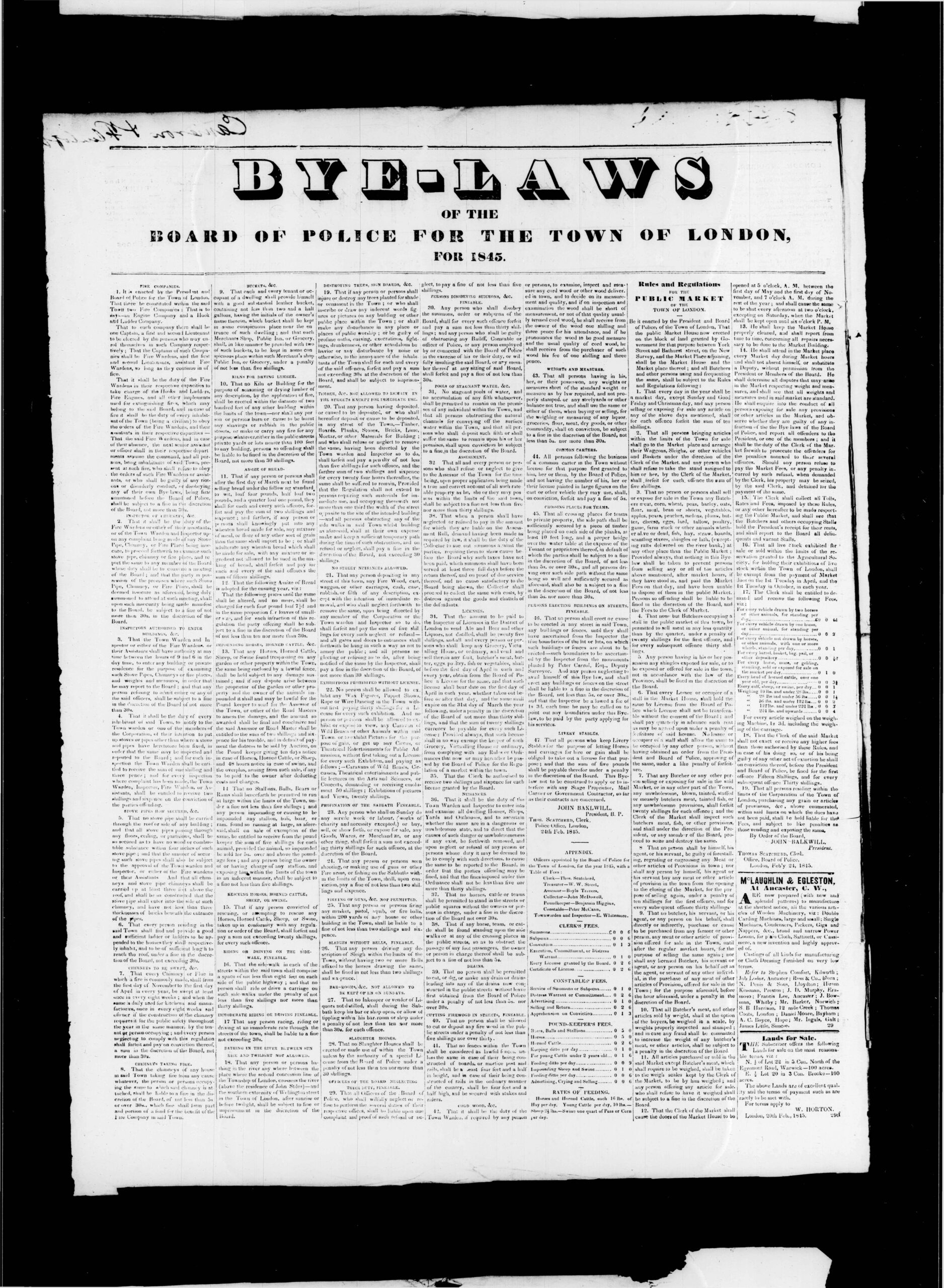
Original 1845 by-laws are posted below for reference.
In 1845, the Town of London formalized one of its earliest known sets of fire-protection regulations. These by-laws, issued by the Board of Police—established the first structured expectations for fire companies, fire wardens, chimney safety, firefighting equipment, and community responsibility.
Though written 180 years ago, the document reveals how seriously early Londoners took the threat of fire, and how many practices remain recognizable today.
Two Fire Companies Formed
The Town formally established:
-
An Engine Company, and
-
A Hook & Ladder Company
Each company elected its own Captain, First Lieutenant, and Second Lieutenant, who automatically became Fire Wardens or Assistant Fire Wardens.
These roles were the forerunners of today’s suppression officers and fire prevention staff.
Fire Wardens were responsible for:
-
Overseeing fire engines
-
Maintaining hooks, ladders, buckets, and equipment
-
Directing citizens at fire scenes
-
Inspecting hazardous chimneys and stove pipes
This marks one of London’s first documented command structures.
Bucket Requirements for Every Household
To ensure rapid firefighting capability, the by-laws required:
-
Every dwelling to maintain one leather fire bucket
-
Every shop, inn, or grocery to have two buckets
-
Buckets must hold 2½ gallons and display the owner’s initials
Buckets were to be placed near the entrance for easy access—an early version of standardized equipment placement.
Mandatory Ladders for All Residents
Every household within the Town limits was required to keep a ladder long enough to reach the roof, ready for use in case of fire.
Failure to maintain a ladder carried fines up to 30 shillings.
This rule highlights how community-based firefighting truly was: every home contributed equipment.
Chimney and Stove Pipe Safety
Fire prevention focused heavily on chimney hazards.
Key regulations included:
-
Chimneys must extend three feet above the roofline
-
Stove pipes could not pass through walls or roofs unless properly secured
-
Chimneys must be swept every eight weeks during winter months
-
Chimneys catching fire resulted in fines of 5 to 30 shillings
Fire Wardens and the Town Inspector could enter homes between 9 a.m. and 6 p.m. to check chimneys, stove pipes, and fire hazards. Failure to allow inspection brought fines.
Prohibition of Kilns and Open Burning
Understanding the risk of urban fires, London adopted strict rules:
-
No kiln or lumber-drying building could be within 200 feet of another structure
-
Burning shavings or rubbish in the street was prohibited
-
No open fire could be built within 100 feet of any building
This foresight reflects the dense wooden construction of the time and the frequency of devastating conflagrations in Canadian towns.
Source: London Inquirer
The original publication is below.