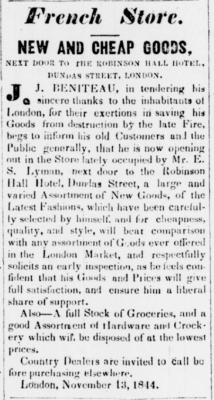
In October 1844, London, Ontario faced a devastating fire that would mark one of the earliest turning points in the city’s history. The blaze destroyed an entire block bounded by Dundas, North (now Carling), Talbot, and Ridout Streets, wiping out businesses, homes, and much of the young village’s wooden core.
At the time, London’s firefighting capabilities were extremely limited. The village, incorporated just five years earlier, relied on a volunteer brigade that was “merely a bucket affair,” supported by a by-law requiring every household to keep a black-painted leather bucket ready for emergency use. Mechanical firefighting equipment did not yet exist in the community.
The destruction caused by the 1844 fire was so severe that it prompted immediate change. In response, the late Hon. G. J. Goodhue purchased London’s first “fire engine,” a simple hand-powered machine described as being only slightly more effective than a watering can but less useful than a lawn sprinkler. Though rudimentary, it represented London’s first step toward organized, equipment-based firefighting.
The Great Fire of 1844 not only reshaped the physical landscape of downtown London, it signaled the need for better fire protection and set in motion the development of what would eventually become the modern London Fire Department.